
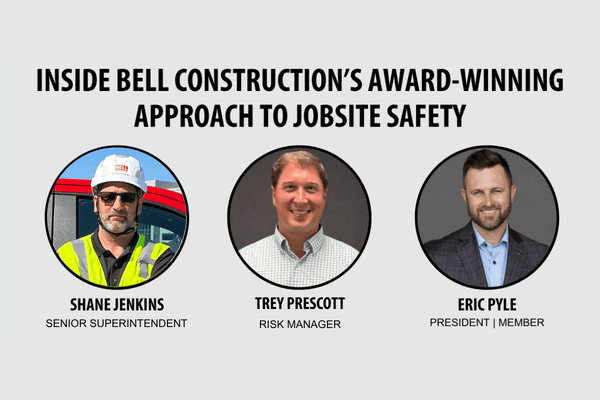
Inside BELL Construction’s award-winning approach to jobsite safety
Each June, National Safety Month is observed, encouraging the construction industry to pause and recognize the systems that protect people on jobsites. At BELL Construction, one of those systems is our Safety Committee.
Although safety is often discussed in terms of rules and checklists, BELL takes a more integrated approach. Safety is part of how work is planned, decisions are made and teams are expected to show up every day. It is one of BELL’s core values and a responsibility shared across leadership, risk management, field teams and trade partners.
BELL has been awarded for its commitment to safety, earning an AGC Construction Safety Excellence Award in 2026, which underscores the strength of the company’s safety practices and the teamwide effort behind them.
“Safety is integrated into every decision, not treated as a separate requirement,” said Trey Prescott, risk manager at BELL. “Of all our company core values, safety is number one, and we treat it as such.”
A committee built for action
BELL’s Safety Committee was created to strengthen safety across the company, and its role has grown over time.
“The Safety Committee’s mission is to promote a safe work environment through continuous improvement, communication and accountability,” Trey said. “It has evolved from a compliance-focused group to a more strategic, collaborative body that actively drives safety initiatives and culture across the organization.”
Safety cannot depend on a manual or a meeting alone. Strong safety practices require people close enough to the work to understand real risks paired with leadership motivated to help solve them. BELL’s committee creates a consistent place to raise concerns, share field insight and turn lessons learned into better practices.
From a leadership perspective, the committee also gives BELL a clearer way to evaluate risk before it reaches the field. Eric Pyle, BELL president and member, explains the goal is to “get ahead of risk” by looking at the company’s safety practices to identify blind spots and learn from others across the industry.
“We strive to plan around exposures in lieu of managing them in the moment to give our teams the best opportunity to go home safely each day,” Eric said.
Where planning becomes protection
Safety starts with planning, and Shane Jenkins, senior superintendent at BELL, has seen the difference it makes on the jobsite with both employees and partners.
“As we build, our focus is on safety every step of the way,” Shane said. “Planning ahead with safety and sequencing efficiency in mind is critical to the success of every project.”
On one BELL project, early safety planning proved critical when three cranes were operating on site at the same time. Before work began, BELL coordinated closely with each trade partner to review crane movement, select paths and site logistics, helping crews work efficiently without swing radius conflicts. The planning created a safer, more organized jobsite and strengthened coordination across the team.
“The result was not only improved safety, but also better productivity, stronger communication between trades and overall, a more successful project outcome,” Shane said.
BELL’s Safety Committee is designed to support a high level of coordination across the company. The committee’s work shows up in how teams prepare for complex work, adjust when conditions change and apply what one project teaches to the next one.
“Serving on the company safety committee allows us to take lessons learned, industry best practices and field feedback and turn them into real actions that impact our jobsites year-round,” Shane said.
How shared understanding improves safety
Construction safety cannot work as a top-down directive. Policies only matter if teams understand them, believe in them and can apply them in the field.
BELL’s Safety Committee creates space for risk, field and leadership perspectives to shape the company’s approach together. Each group brings a different view of what teams need, where hazards show up and how expectations can be put into practice.
“Having a diverse committee allows us to have hearty discussions around hazards, policies and procedures that we can actually implement and enforce,” Eric said. “Not just a top-down approach that nobody believes in, but a platform for us to come together and agree to what is best for our team and our partners.”
Keeping people at the center
BELL’s safety culture extends beyond policies and procedures. It depends on people who are willing to speak up, share what they are seeing and hold one another accountable in the field. Shared responsibility also influences the partners BELL brings onto its jobsites.
“When we are choosing to pursue a project or select our trade partners, we want to know they have the same elevated care for their employees as we do,” Eric said.
For BELL, safety is part of alignment. The strongest partners are capable of doing the work while sharing best practices and taking ownership in creating a safer project environment. BELL’s Safety Committee helps reinforce that standard, but the purpose behind the work is much simpler.
“The most important reason everyone on the jobsite should prioritize safety is to ensure every worker goes home safely to their families every day,” Shane said. “At the end of the day, nothing is more important than protecting the people on our projects.”
During Safety Month and throughout the year, BELL’s commitment is to protect the people who make each project possible. Learn more about how BELL builds safely and responsibly on our Safety page.
