
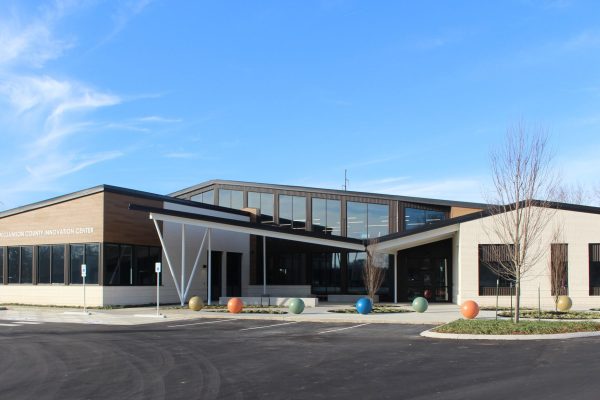
Building what’s next: How BELL partnered to bring the Williamson County Schools Innovation Center to life
Authors:
- Tyler Powell, Member and Project Executive at BELL Construction
- Kris Schneider, Assistant Director of the Innovation Center at Williamson County Schools
Great projects start well before ground is broken. For the Williamson County Schools (WCS) Innovation Center, that meant aligning the district, design team and BELL Construction around a shared vision, a defined budget and a clear plan to deliver lasting value early on.
While BELL’s work is complete, WCS is awaiting to open the doors to students for the start of the 2026 school year. The facility will bring multiple career pathways together, giving students across Williamson County access to hands-on learning environments designed to feel like the workplace instead of a traditional classroom.
For BELL, the assignment went beyond delivering a building. From day one, the focus was on partnership and translating big ideas into buildable solutions. Together, BELL and WCS kept the project moving with clarity, communication and long-range thinking.
A shared vision from the start
The concept of the Innovation Center challenged conventional K-12 design. This wasn’t a classroom; it was an immersive learning experience for students to explore careers not taught in ordinary curricula.
“We didn’t want this to look or feel like a traditional school,” said Kris Schneider, Assistant Director of the Innovation Center. “We wanted it to reflect the modern workplace.”
Early planning sessions brought district leadership, Kline Swinney Associates (the Architect) and BELL to the same table to explore how that vision could translate into a functional, durable facility. Those conversations set the tone for the project.
“It was clear early on that everyone was invested,” Schneider said. “There was genuine excitement around doing something different.”
From BELL’s perspective, delivering on the vision required early clarity and steady communication. The project was funded through a state grant with a defined budget, making early cost guidance essential.
“The construction management approach allowed us to stay engaged throughout design and continuously evaluate options against the available budget,” said Tyler Powell, BELL Construction Member and Project Executive. “That gave the district clarity and flexibility as decisions were made.”
Rather than reacting to cost at the end of design, the team proactively evaluated ideas in real time to identify opportunities and maximize value without compromising intent.
Turning opportunity into added capacity
One of the most significant examples of collaboration was the decision to expand the building vertically.
The original concept called for a smaller footprint, but as design progressed and budget alignment became clearer, the team identified the opportunity to add a partial second level. Because the parcel is largely surrounded by floodplain, the footprint could not significantly expand. Building up allowed the district to more effectively use available grant capacity.
The final design grew 33% larger to approximately 24,000 square feet, adding flexible classroom space and expanded storage tied to required storm shelter construction.
“That additional space gives us flexibility and room to grow,” Schneider said. “It positions us to serve more students over time.”
The decision reflects a broader theme of the project: aligning immediate needs with long-term adaptability. Spaces throughout the Innovation Center were intentionally designed to evolve as workforce demands change.
“The programs that exist today may shift in the future,” Powell said. “Our team approached the layout with that in mind, making sure the building can adapt as the district’s priorities evolve.”
Coordinating complexity with precision
Behind the scenes, the Innovation Center required detailed coordination across disciplines. The building includes extensive masonry, rake walls and trapezoidal window openings, all of which demanded precise embed placement and layout sequencing. Much of the interior features exposed concrete flooring, which called for intentional construction planning to protect finished surfaces throughout the build.
At the same time, the project introduced elements atypical of a traditional school facility, including specialized labs, welding areas and industrial equipment spaces. BELL coordinated closely with design partners and regulatory authorities to ensure safe integration of these systems.
Throughout construction, BELL leveraged digital project management platforms and 360-degree site capture to maintain transparency and documentation. Weekly coordination meetings, structured communication channels and consistent schedule tracking kept stakeholders aligned.
“This was one of the district’s first construction management projects in some time,” Powell said. “Part of our responsibility was helping guide the process so everyone understood how decisions moved and how we maintained accountability.”
The result was a disciplined, team-oriented environment that prioritized clarity and collaboration.
Investing beyond the project
For BELL, building the Innovation Center also meant investing in the students it will serve.
Student engagement was incorporated into the project schedule from the beginning, with multiple job site tours hosted for high school students across Williamson County. Students from agriculture, construction and engineering pathways were able to see the building in progress, interact with trade professionals and experience hands-on simulations through the “Be Pro, Be Proud” simulation truck, a workforce-development program BELL supports through industry sponsorships for Tennessee-area high schools.
“We’re committed to workforce development,” Powell said. “Creating opportunities for students to see construction firsthand is part of that commitment.”
The team also coordinated a structured student placement on the project, providing real-world exposure to construction operations and project management. Those efforts were not required by contract, but aligned with BELL’s broader mission of investing in the communities where it builds.
“There was a shared understanding that this building is about opportunity,” Schneider said.
Local roots, long-term relationships
The Innovation Center sits in the community that many BELL team members call home. Powell lives minutes from the site. The project superintendent is a Franklin High School graduate. That proximity reinforced a sense of ownership and pride.
“When you build in your own community, it carries weight,” Powell said. “You approach it with a long-term perspective.”
That perspective extends to the relationship with Williamson County Schools. The project demonstrated how a construction management approach can provide cost certainty, transparency and collaborative problem-solving within public funding constraints.
“I’m proud of the partnership we built,” Powell said. “We worked through decisions together, maintained alignment and delivered a facility that reflects the district’s goals.”
A foundation for what comes next
As applications for the Innovation Center opened, interest quickly exceeded initial projections, signaling strong demand for career-focused education. The building is designed to serve up to 525 students at capacity, with room to expand programs as industries evolve.
The Innovation Center stands as a model for what can happen when vision, discipline and partnership intersect. It reflects Williamson County Schools’ commitment to preparing students for high-demand careers and BELL’s commitment to delivering projects that strengthen the communities it serves.
BELL measures success not only in square footage delivered, but in trust earned. With more than five decades of building across Middle Tennessee, the Innovation Center continues BELL’s legacy of relationship building and community engagement.
